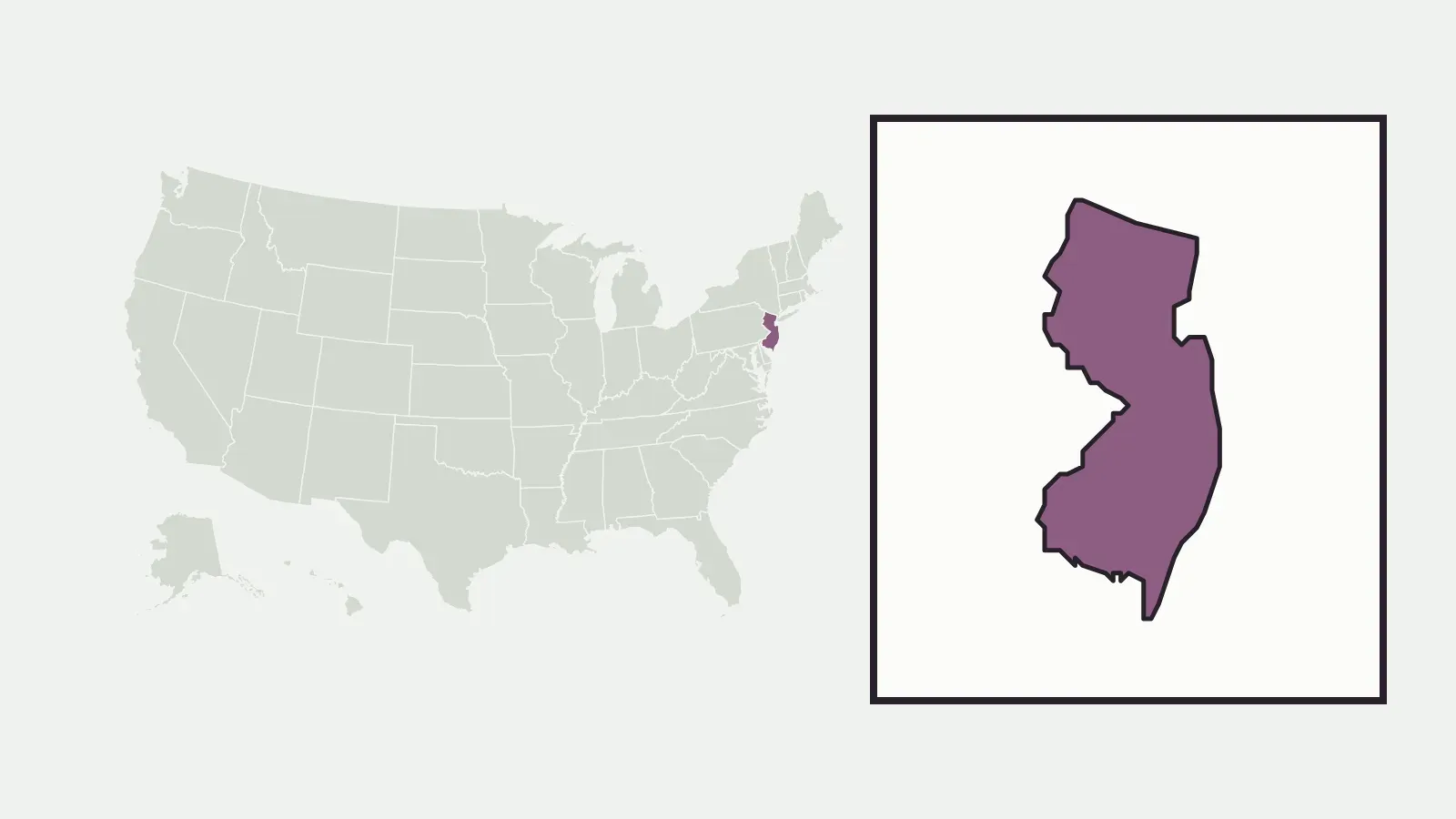
Price level 108.8
Remodeling in New Jersey: registered contractors and a uniform state code
Highest-tier price level, a state registry every home improvement contractor must join, and contract rules that start at $500.
By RenovaOak Editorial Team Updated 6 min read
- Price level
- 108.8 (U.S. = 100)
- Contractor license
- State registration
- Contract rules
- Written contract over $500
In short
New Jersey's price level is 108.8, in the highest tier, but that index covers household costs and not remodeling. A home improvement contractor must be registered with the Division of Consumer Affairs before offering or doing work, and a 2024 law created a licensing board whose start date I could not confirm. A contract above $500 has to be written and signed, and you get three business days to cancel. The state code is uniform, with the 2024 IRC (NJ edition) adopted August 17, 2026. EPA runs the lead-safe rule.
New Jersey at a glance
How to read 108.8
The Bureau of Economic Analysis puts the national household price level at 100 and compares each state against it. New Jersey's 2024 reading is 108.8, one of the highest on the map. The figure is built from rent, groceries, utilities and similar household purchases. It is not a remodeling price, and it says nothing about what a floor, a vanity or a wall removal will cost on your street.
Ask local contractors for three written bids and compare them in the bid comparison tool. For a sense of wages in your area, the BLS OEWS tables at data.bls.gov/oes list carpenters, electricians and plumbers by region.
Who may do the work
Any home improvement contractor business that makes or sells home improvements in New Jersey must register each year with the Division of Consumer Affairs, according to the Division's FAQ. That covers part-time contractors, subcontractors and out-of-state firms. Under N.J.S.A. 56:8-138, a contractor business may not offer or perform home improvement work unless it is registered. Owners or their family members working on their own residential property are among the exemptions listed in N.J.S.A. 56:8-140.
Registration now carries insurance conditions. The Division's notice says a business needs commercial general liability insurance (at least $500,000 per occurrence for home improvement contractors), workers' compensation insurance unless exempt, and additional security such as a compliance bond. Ask to see the certificate of insurance and the registration number, which businesses must show on cards, vehicles, ads and documents.
A 2024 law, P.L. 2023, c. 237, created the State Board of Home Improvement and Home Elevation Contractors and a licensing act. The statute's text I read keeps its licensed-contractor staffing rules inoperative until the board adopts implementing rules, and the Division's notice describes registration as the current requirement. I did not find a licensing start date, so check the Division before you assume either way.
The penalties for working unregistered are civil penalties of up to $10,000 for a first offense and up to $20,000 for later ones, and a knowing violation may be a fourth-degree crime. Read choosing a remodeling contractor for the questions that registration does not answer.
The contract and payment rules
New Jersey has a detailed home improvement contract rule. A contract for a purchase price above $500, and every change to its terms, must be in writing and signed by all parties (N.J.A.C. 13:45A-16.2; N.J.S.A. 56:8-151).
| Item | What the rule says |
|---|---|
| Parties | Legal name and business address of the seller and of the salesperson who negotiated it |
| Work | A description of the work and the main products and materials, with make, model and size where they apply |
| Price | The total price including finance charges, or the hourly labor rate for time-and-materials work |
| Dates | Start and completion dates, or the period for the work |
| Insurance | A copy of the commercial general liability certificate, and the insurer's phone number |
| Cancel notice | A conspicuous notice in at least 10-point bold type |
You may cancel until midnight of the third business day after you receive a copy of the contract. The notice must be in writing, sent by registered or certified mail with return receipt requested, or delivered in person to the address in the contract. Refunds are due within 30 days. I found no deposit limit in the sections I read. The change orders page shows how to keep every change inside that signed paper.
Permits and code
New Jersey's Uniform Construction Code is statewide, and the ICC says local jurisdictions may not amend it. The Department of Community Affairs lists the residential subcode as the International Residential Code 2024, New Jersey edition, with an adoption date of August 17, 2026, and the electrical subcode as the 2023 National Electrical Code. DCA also lists a separate Rehabilitation Subcode, at N.J.A.C. 5:23-6, for work on existing buildings; ask your building office which subcode governs your job.
The page I read gives an adoption date and not an effective date, so check with your municipality which edition it applies to a permit filed today, as of November 2026. See permits for interior remodels for what often needs a permit. Moving a wall is a common reason; the open floor plan page covers it.
Lead-safe work in older homes
New Jersey is not an EPA-authorized state, so EPA runs the Renovation, Repair and Painting rule. Paid work that disturbs paint in a home built before 1978 calls for an EPA-certified firm. Work that disturbs 6 square feet or less per room inside, or 20 square feet or less outside, is excluded, with window replacement and demolition of painted surfaces as exceptions. EPA says homeowners are generally not covered on their own pre-1978 home. Details are in lead paint and asbestos in older homes.
Where to check and complain
- Registration and complaints: Division of Consumer Affairs, njconsumeraffairs.gov. The Division's page lists 1-888-656-6225 for registration forms.
- Your municipality's building or construction office: permits and inspections.
- Keep the signed contract, the insurance certificate and any cancellation notice together in one folder.
Common questions
Must a New Jersey contractor be registered?
Yes. A business that makes or sells home improvements must register each year with the Division of Consumer Affairs. Owners working on their own residential property are exempt.
When does a contract have to be in writing?
When the purchase price is more than $500. Changes must be in writing too, and all parties must sign.
Can I cancel a home improvement contract?
Yes, until midnight of the third business day after you receive a copy of the contract, by written notice sent by registered or certified mail or delivered in person.
Can my town set its own residential code?
The ICC says the codes are uniform statewide and local jurisdictions may not amend them. Ask your construction office which edition it applies.
Sources
- NJ Division of Consumer Affairs: Home improvement contractor FAQ
- NJ Division of Consumer Affairs: Changes to the law, new requirements for registration
- N.J.S.A. 56:8-138, registration (Justia)
- N.J.S.A. 56:8-151, home improvement contracts (Justia)
- N.J.A.C. 13:45A-16.2, unlawful practices (Cornell LII)
- NJ Department of Community Affairs: current construction codes
- ICC: New Jersey code adoptions
- EPA: Lead Renovation, Repair and Painting Program
- FRED: BEA regional price parity, New Jersey (NJRPPALL)
Checked November 19, 2026. Read: the Division of Consumer Affairs FAQ and its notice on registration changes, N.J.S.A. 56:8-138 and 56:8-151 as shown by Justia, N.J.A.C. 13:45A-16.2, the DCA current-codes page, the ICC adoption page and EPA's RRP page. The Division's own pages for registration and its brochure did not load. Not confirmed: when the licensing act takes effect, the exemptions in N.J.A.C. 13:45A-17.4, the effective date of the 2024 residential subcode, whether the Rehabilitation Subcode applies to a given job, and any deposit limit. Justia warns its text may not be current. Price level: BEA release 26-10 (February 19, 2026); the next release is due December 10, 2026. A second check on November 20, 2026 read the main official pages again; it did not re-confirm the licensing board start date.
Keep reading
-
Planning guide
Choosing a contractor
Scam signs, license and insurance checks, comparable written bids, contract basics and what to do in a dispute.
-

Planning guide
Change orders and payment schedules
Put every change in writing, understand allowances and contingency, and pay in a way that protects you.
-
Planning guide
Permits for interior remodels
What usually needs a permit, what does not, a call script for your building department, and the inspection order.